
This article aims to help website publishers achieve higher levels of performance in their digital activities while optimising their CMP (Consent Management Platform).
In accordance with the GDPR and the ePrivacy Directive, all European websites that use cookies have had to implement a CMP to collect and manage their users' choices.
You have probably come across hundreds of them, which is not always pleasant as a user!
This is the dialogue box that appears when you arrive on a website to collect users' privacy choices.
This tool is often restrictive, but it is now the new foundation for maintaining digital activities.
Incorrect configuration can have serious consequences for the website's compliance and performance.
To ensure that you configure your CMP correctly while maintaining a high consent rate, let's take a look at 8 preconceived ideas on the subject :
1 - “Design is extremely important” >> FALSE
In reality, design is not the key factor. It has little influence on the consent rate.
However, it is still recommended that you use your website's main colour on your CMP and include your logo.
2 - “The text should be short !” >> FALSE
The text is a key element for compliance.
It is important to note that the length of the text will not impact the user's choice.
However, it is impossible to justify that your user's consent is valid without displaying what the authorities require.
>> Tip : Do not overdo it by minimising the text.
This will not have a positive impact on your consent rate, but will simply invalidate the user's consent.
For example, for consent to be considered ‘informed’ (one of the four characteristics of consent in the GDPR), the user must at least be able to access dozens of pieces of information before being able to make a choice.
Here are a few examples:
- List the purposes,
- provide a link to the list of partners in one click without scrolling,
- define the scope of application of consent and its duration,
- explain to the user how to object, change their mind, etc.
This information must appear on the first screen of the CMP.
3 - “Apply a refusal mechanism” >> TRUE
Since the CNIL recommendations of 1 April 2021, it is mandatory to offer a ‘bulk refusal mechanism’ to users located in France.
This means that if the user has the option to accept with one click, they must also be given the option to refuse with one click.
>> Tip: choose CMPs that are compatible with market standards such as IAB Europe's TCF V2, Google Consent Mode, and BING consent mode.
This will allow you to offer a ‘continue without accepting’ button (or link) rather than ‘refuse everything’.
In the absence of consent, it will then be possible to maintain the legal basis of legitimate interest (one of the six legal bases of the GDPR) and to carry out certain processing operations that do not require consent.
4 - “Add as many partners as possible” >> FALSE
It is essential not to overlook any partners or purposes in order to ensure that consent is specific.
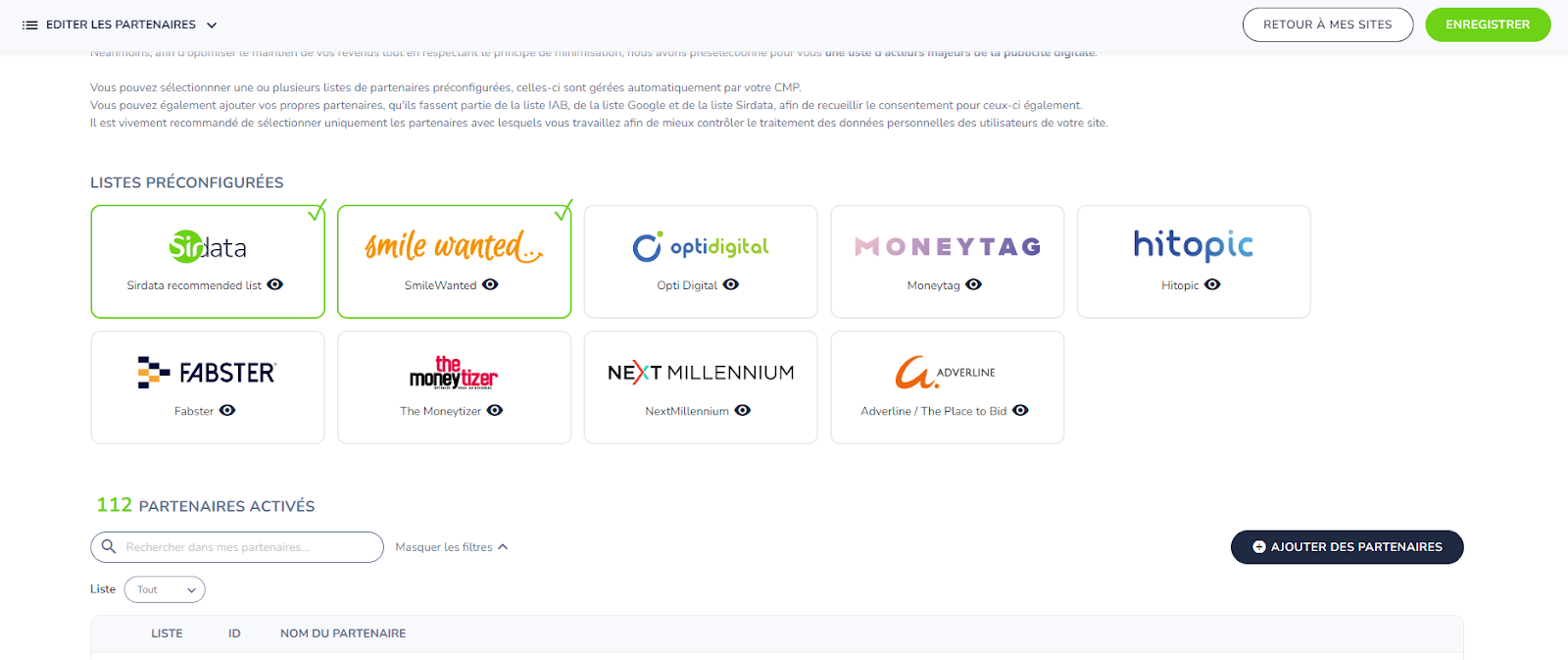
If your CMP is based on IAB Europe's TCF V2, you can select and automate the integration of your partners with a single click.
You will not need to enter their purposes or the associated legal bases yourself. Everything will be automated.
>> Tip: there is no need to select too many partners. Limit yourself to your direct and indirect partners that you use on a daily basis.
Displaying non-partner companies will slow down the loading of the CMP and destroy the user experience. This is because the CMP will have to be displayed to collect consent, even for companies with which you do not share any activity.
At Sirdata, we provide a default list so that no key players are overlooked, and we also offer pre-configured lists from various advertising agencies.
5 - “Block browsing” >> it depends
This is a very important question.
The answer depends on your needs and the type of activities you carry out.
If you want to maximise your consent rate, we strongly recommend activating the overlay option (freezing the page) in your CMP.
Why? Because without an overlay, a large part of your audience will not interact with the CMP and therefore will not give their consent.
If the consent rate is not the primary objective and you want to focus on a smoother user experience, the overlay can be deactivated.
6 - “All CMPs have the same technical features.” >> FALSE
The bodywork is fine... But the engine is what really matters!
Most of the features that guarantee an optimal consent rate are not visible at first glance.
As you can see, while design is not a key factor in the performance of a CMP, the engine certainly is!
At Sirdata, we offer three technical features that natively boost consent rates :
- The cooperative for sharing choices : Scope Group
The Scope Group allows user consent to be shared between several websites belonging to the same group. In practical terms, when a user accepts or refuses cookies on one website, their choice is automatically recognised on the other websites in the group, which means they are not asked for their consent again each time they visit.
This feature improves the user experience by reducing the repetitive display of consent banners, a phenomenon often referred to as ‘consent fatigue’. By limiting these requests, browsing becomes more fluid and users make more informed consent decisions, while increasing acceptance rates.
The system is based on a consent domain, which centralises and stores user preferences so that they can be applied to all sites within the group, while complying with GDPR requirements.
Configuration is carried out via the ABconsent platform, where you simply create a group of sites, associate a consent domain with it, and add the relevant sites.

- The intelligent application of choices
Never call into question consent that is still valid.
All CMPs on the market operate in a binary manner. If you list 50 partners and consent is missing for one of them, the CMP will automatically display to collect the user's choice regarding the use of their personal data by the partner who has not yet obtained consent. However, when it displays, it will also call into question the choices already obtained for the other 49 partners.
At Sirdata, we display a specific screen allowing the user to apply their choice only to new partners and/or new purposes.
In the event of refusal, the new companies (partners) do not benefit from consent, but the existing partners retain the consent already obtained.

- The Capping
The CNIL rightly requires that the retention period for the user's choice be the same whether it is consent or refusal.
The recommendation is 180 days (6 months).
However, retaining the choice does not mean that the CMP has to be displayed again.
At Sirdata, we store users' choices for 6 months by default, but allow publishers to set the period during which their CMP will not be redisplayed. That said, in order to avoid refusals due to over-solicitation, in the absence of a choice or consent, we prevent the CMP from being redisplayed for less than 24 hours.
This prevents users from being harassed while browsing, even if they move from one site to another and even if their session has ended.
If the user refuses, whether they return to your site the next day or even five months later, we will record the refusal but will display the CMP again at the same time if the publisher so wishes.
If the user does not make a choice, their refusal will remain active.
Managing the CMP redisplay capping allows the publisher to convert (or at least attempt to convert) refusals into consents.
We can compare this technique to what happens in a shop when you refuse to take a loyalty card... they offer it to you again every time you come back ;) The difference here is that we impose a cap...
7 - “A CMP only allows consent to be collected.” >> FALSE
It is important to analyse the existing services around the CMP.
The CMP is the new foundation for managing your digital activities.
Optimising the consent rate is essential, but alternatives must also be explored.
- Can the CMP help you manage your choices and, in particular, manage the effects of those choices ?
Does it offer :
- solutions when the user does not give their consent?
- the triggering of cookies and other tracking pixels based on the user's choice (tag conditioning)?
- compatibility options with the most commonly used tags, such as Google Analytics or Bing, with the activation of their respective ‘Consent Mode’
- or proxyfication products to secure data transfers to the United States?
- options to properly condition the reading of video players using cookies ?
Is it offered with services that enable you to :
- audit your integration?
- receive support from experts?
8 - “I need a CMP that I can configure entirely according to my own criteria.” >> FALSE
Generally speaking, integrating a CMP is child's play.
Very often, all you need to do is copy and paste a script to activate the solution.
However, you must ensure that :
- The consent collected is valid
- The CMP will automatically adapt itself to the new rules and recommendations of the CNIL and any other competent authority.
For example, since 1 April 2021, the 25,000 publishers using the Sirdata CMP have automatically seen a refusal mechanism appear on their websites, as it has become mandatory. Failure to implement it would have invalidated all user consents obtained since that date.
Some CMPs will prioritise their clients' requests for fear of losing them, but this will be to the detriment of compliance and their advisory role.
>> Tip: opt for simple, stand-alone installations !
Car c’est le rôle d’une CMP que d’être au fait des lois applicables (et de leur date de mise en application) en matière de protection des données et de faire bénéficier automatiquement ses clients de ses mises à jour voire de ses nouvelles fonctionnalités.
Vous avez désormais toutes les cartes en main pour réussir votre intégration.
N’hésitez pas à solliciter directement les CMP providers pour approfondir ces éléments lors d’un call.
Éditeur de sites, bonne chance à vous !